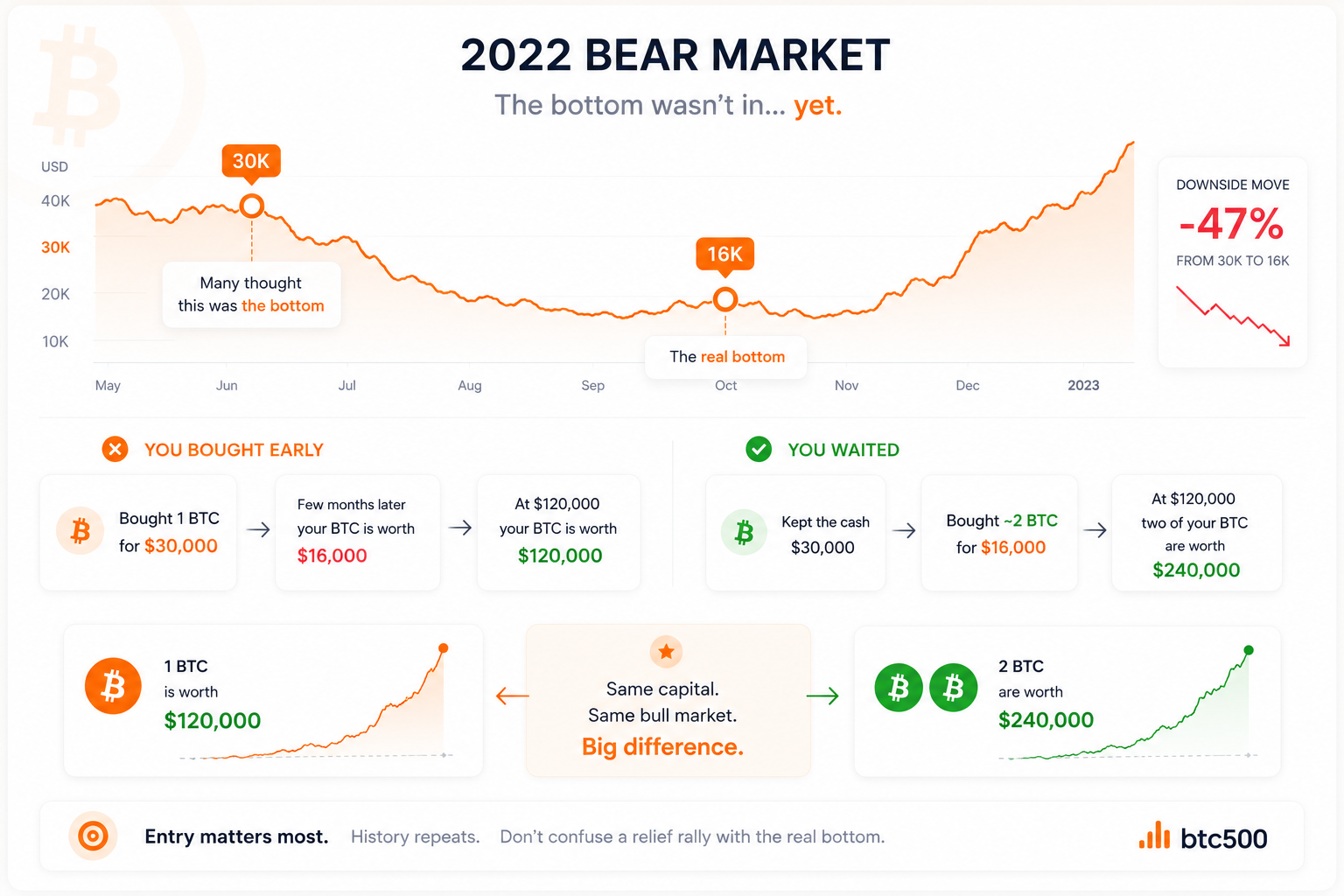
Every Bitcoin cycle ends the same way: the crowd finally agrees on a bottom, and then the market refuses to deliver it. The consensus bottom is the one that never happens.
Right now, the market is split into three camps. The largest group expects Bitcoin to bottom between $40,000 and $50,000 in September or October. A second group believes the bottom is already behind us. A third group is waiting for a deeper flush to the $28,000–$33,000 range.
The most popular opinion is the $40,000–$50,000 target. And that is precisely the problem.
The Consensus Bottom Is a Trap
When an entire market agrees on the same bottom target in the same month, that target loses its power. The bottom the crowd is waiting for is the bottom the market will not deliver in the way they expect.
This isn't speculation — it's a pattern that repeats every cycle. In 2022, the crowd was convinced $30,000 was the floor. Analysts called it. Influencers celebrated it. Social media was filled with confidence. Then Bitcoin fell to $16,000.
Key insight: The market doesn't reward the consensus. It rewards the minority who understand that when everyone is looking at the same price level, that level becomes the most crowded trade in the room — and the most likely to fail.
What the MA200 Weekly Actually Tells Us
Bitcoin has lost its 200-week moving average again. For many investors, this sounds like a warning. For anyone who has studied Bitcoin's history, it's the opposite.
Every time Bitcoin has traded below the MA200 weekly, it has historically been a significant buying opportunity. The current price action sits directly at and below this level — the same zone where previous cycle bottoms have formed.
This is not the zone where you panic. This is the zone where disciplined investors build positions.
Forced Selling Creates the Best Entries
The most interesting development this week involves one of Bitcoin's most prominent corporate holders. After years of declaring he would never sell, the CEO of Strategy (formerly MicroStrategy) is now reportedly considering selling $5 billion worth of Bitcoin — at a price point near the current accumulation zone.
The man who bought at $100,000, $110,000, and $120,000 — often with leverage — is now facing a position that forces his hand at $60,000 instead of $120,000. This is what happens when you have no plan: the market makes the plan for you, and the market's plan is always worse than the one you refused to make yourself.
Why this matters: Forced selling from a trapped whale is exactly the kind of liquidity event that marks accumulation zones. When a large holder is forced to sell into weakness, it creates the deep prices that patient buyers have been waiting for.
The BTC500 Perspective: Accumulate Before Confirmation
Here's the fundamental truth that separates disciplined investors from the crowd: accumulation happens before confirmation. By the time the market officially declares a bull market, the biggest opportunity has already passed.
The BTC500 strategy is built on this exact principle. You buy approximately 500 days before the halving — during the bear market, when prices are low and sentiment is negative. You don't wait for the crowd to agree that the bottom is in. You buy when history says the odds are in your favor.
The Core Strategy
SELL: 500 days after halving
No complex indicators. No emotional trading. Just discipline.
The greatest investments are made in bear markets — not after everyone agrees a bull market has already begun. Those who can only think in black and white fail to understand that the transition zone is where the biggest opportunities are created.
Why the Crowd Keeps Getting It Wrong
The crowd's behavior follows a predictable pattern. At the top, they call the cycle a "disgrace" and refuse to believe in the four-year cycle. At the bottom, they suddenly become believers — but only in the lows they've cherry-picked for themselves.
If the four-year cycle is real, it applies to both the highs and the lows. You can't dismiss it at $120,000 and then embrace it at $50,000. That's not analysis — that's greed wearing the mask of conviction.
- At the top: The crowd laughs at cycle targets and calls for new ATHs.
- In the middle: The crowd adopts yesterday's bearish targets as their own.
- At the bottom: The crowd waits for a level that will never come, because everyone is waiting for it.
What History Says About Buying in Bear Markets
Bitcoin's halving cycle creates a recurring pattern. The 500 days before each halving have historically been the accumulation window — the period when prices are most undervalued relative to the coming cycle.
The current market sits in a similar position. The bear market is real. But so is the opportunity it creates for those willing to act before the crowd.
The Takeaway
Nobody rings a bell at the bottom. Nobody knows the exact day Bitcoin will reverse. But history leaves clues.
The crowd waits for $40,000–$50,000 in September or October. Disciplined investors accumulate in the current range, knowing that the consensus bottom is the one the market is least likely to deliver.
The investors who succeed over multiple cycles aren't usually the ones making the boldest predictions. They're the ones following a disciplined, repeatable strategy — buying when history suggests the odds are in their favor, not when the crowd finally agrees.
That's exactly what BTC500 is built around. Not predicting the future — but making better decisions by learning from Bitcoin's past.
Important: This article is for educational purposes only and does not constitute financial advice. Always do your own research and consider consulting with a financial advisor before making investment decisions.