When analyzing Bitcoin's market cycles, one of the most powerful on-chain indicators is the Net Unrealized Profit/Loss (NUPL) — also known as Relative Unrealized Profit/Loss. It reveals whether the market as a whole is sitting on profits or losses, and more importantly, it maps directly to the emotional phases of every Bitcoin cycle.
What is NUPL?
(Total Profit / Loss held across all Bitcoin wallets)
When NUPL is positive, the market is in profit. When negative, the market is at a loss. The magnitude tells you just how deep into greed or fear the market has moved.
Bitcoin RUPL Chart
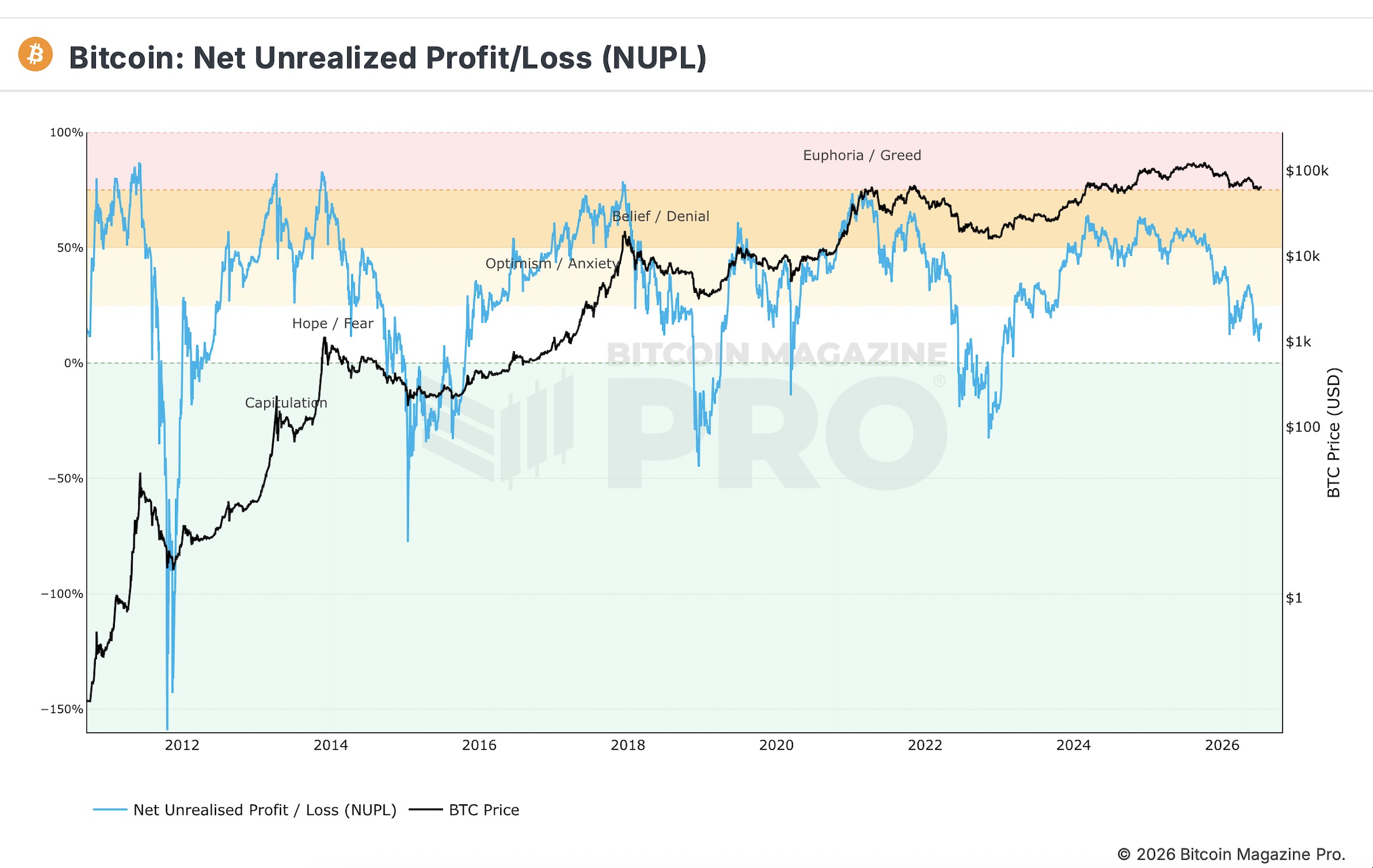
The chart below shows Bitcoin's Relative Unrealized Profit/Loss over time. Each colored band corresponds to a distinct phase of market sentiment — from disbelief and hope all the way to euphoria and capitulation.
The Five Phases of NUPL
NUPL doesn't just show profit and loss — it maps to the emotional cycle of the market. Each phase has historically aligned with specific periods in Bitcoin's four-year halving cycle.
Phase 1 — Disbelief (Green / 0–0.25): After a bear market, price begins recovering but most investors remain skeptical. NUPL is positive but low. Historically this occurs in the early post-halving period.
Phase 2 — Hope & Optimism (Yellow / 0.25–0.50): The market gains momentum. More investors become profitable. This phase often begins around the halving event itself, as supply constraints start to take effect.
Phase 3 — Belief (Teal / 0.50–0.75): The bull market is well underway. The majority of Bitcoin holders are in profit, and confidence is building. This maps to the mid-cycle rally period.
Phase 4 — Euphoria (Green high / 0.75–1.0): The peak of the cycle. NUPL reaches its maximum as almost every holder is in significant profit. This has historically coincided with the cycle top, roughly 500–600 days after the halving.
Phase 5 — Capitulation (Red / below 0): The bear market takes hold. NUPL turns negative as the majority of holders are at a loss. This is the phase where weak hands sell, setting the stage for the next cycle.
Why NUPL Matters for the BTC500 Strategy
The BTC500 strategy and NUPL are natural companions. Here's how they align:
- Buying at "Disbelief": The 500-day pre-halving buy window typically places you in the Disbelief or early Hope phase — when NUPL is low but positive. This is precisely when Bitcoin is most undervalued relative to the coming cycle.
- Holding through the cycle: As the halving approaches and passes, NUPL moves through Optimism into Belief. This is your holding period — and NUPL confirms you're on the right track.
- Selling at "Euphoria": The 500-day post-halving sell window targets the Euphoria phase. When NUPL enters the 0.75–1.0 range, it signals that almost the entire market is in profit — historically a reliable indicator that the cycle top is near.
- Avoiding "Capitulation": By selling 500 days after the halving, you exit before the NUPL turns negative. This is the key to locking in profits and avoiding the bear market.
How NUPL is Calculated
Understanding the math behind NUPL helps you trust the signal:
- Market Cap = Current price × Total circulating supply (what the market says Bitcoin is worth right now).
- Realized Cap = Each UTXO valued at the price when it last moved (what Bitcoin holders actually paid, on average).
- NUPL = (Market Cap − Realized Cap) ÷ Market Cap
The result is a ratio between -1 and +1 that represents the average unrealized profit or loss across all Bitcoin holders. When the ratio is normalized in this way, it's often called Relative Unrealized Profit/Loss (RUPL).
Key insight: Realized Cap removes the noise of short-term price volatility by looking at the cost basis of the entire market. When price surges far above what most people paid, NUPL rises. When price drops below the average cost basis, NUPL turns negative.
Practical Ways to Use NUPL
1. Cycle Timing
Track NUPL alongside the BTC500 countdown. When NUPL dips into the Disbelief range after a bear market, it's a confirmation signal that the next accumulation window is opening. When NUPL enters Euphoria, it's time to prepare your sell orders.
2. Risk Management
During the holding period (between your buy and sell dates), NUPL can help you stay calm during corrections. If NUPL remains positive and above 0.25, the cycle is still intact. Sharp drops into negative territory warrant attention.
3. Comparing Cycles
By normalizing NUPL as a ratio, you can compare different halving cycles directly. The peaks of each cycle's Euphoria phase provide a consistent reference point for understanding where we are in the current cycle.
Limitations to Keep in Mind
No indicator is perfect. Here are the key limitations of NUPL:
- Lagging indicator: NUPL confirms trends rather than predicting them. It's excellent for validation, less useful for precise timing.
- Extreme readings can persist: The Euphoria phase can last for months, making it difficult to pinpoint the exact top.
- Doesn't account for external factors: Regulatory changes, macroeconomic conditions, or black swan events can override on-chain signals.
- Best used in combination: NUPL works best alongside other indicators like the Puell Multiple, MVRV Z-Score, and the BTC500 timeline.
Bringing It All Together
The Relative Unrealized Profit/Loss (NUPL) chart is one of the most transparent windows into Bitcoin market psychology. It strips away the noise and shows you, at a glance, whether the market is driven by fear or greed, despair or euphoria.
For BTC500 practitioners, NUPL serves as the perfect companion indicator. It validates that the strategy's fixed windows align with the actual emotional and financial state of the market. When the countdown says "buy" and NUPL says "disbelief," the stars are aligned. When the countdown says "sell" and NUPL says "euphoria," it's time to act.
Use the chart above to understand the current market phase, and cross-reference it with your BTC500 timeline to make informed, confident decisions throughout each halving cycle. For the latest interactive data, visit Bitcoin Magazine Pro.
Important: This article is for educational purposes only and does not constitute financial advice. Always do your own research and consider consulting with a financial advisor before making investment decisions.